
New district policy officially enforces phone pockets
Entering the ’25-’26 school year, most Samo students are already used to storing their phones away for when class is in session. But many may notice that instead of having only a handful of phone-free classes like last year, phones must now be put away in every class. This is because the Santa Monica-Malibu Unified School District (SMMUSD) has implemented a policy which restricts electronic devices during academic hours. Starting this school year, what was once up to teachers is now a district-wide policy.
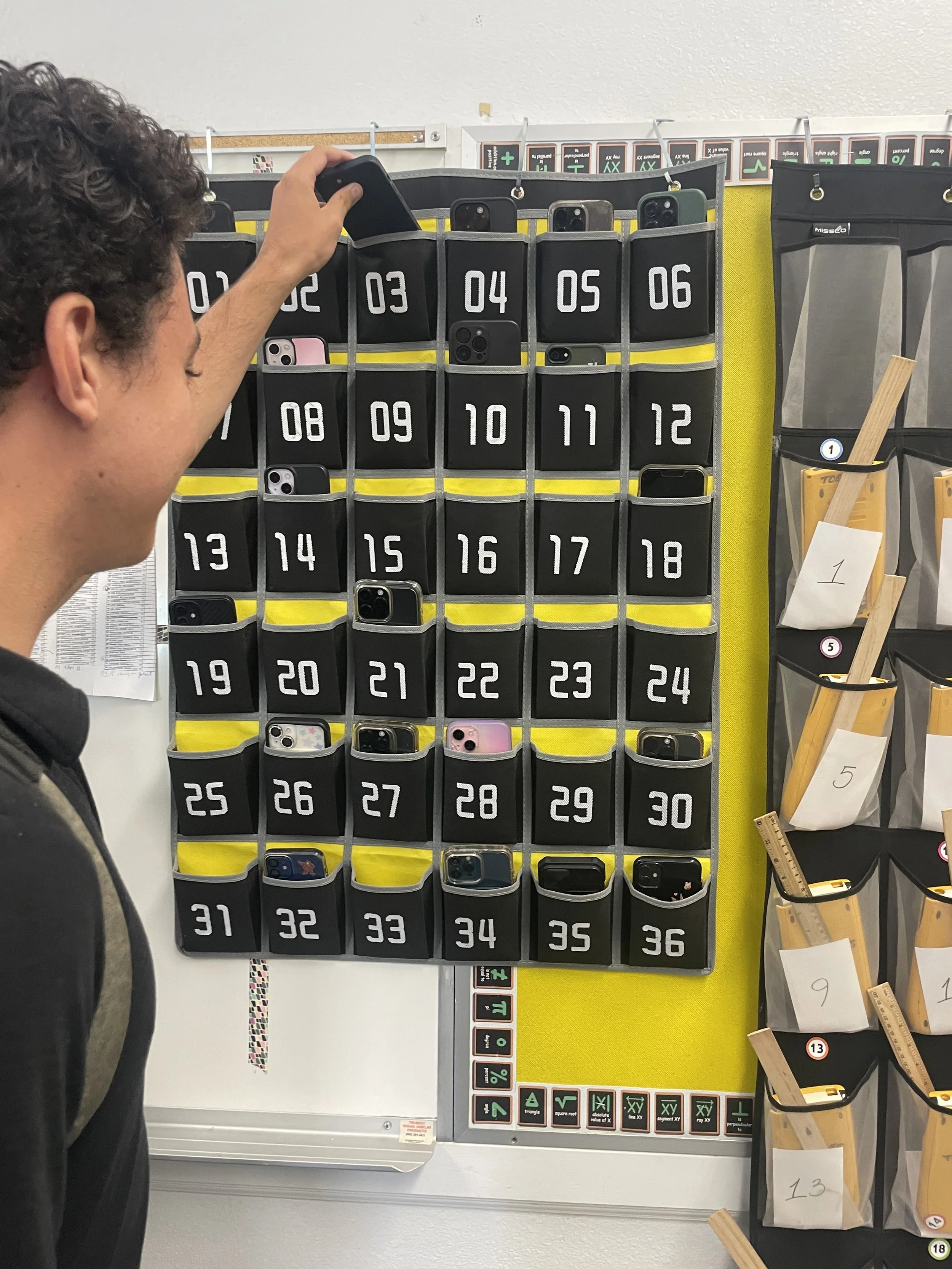
Student seen placing his phone into his teacher’s phone pocket.
The BP 5131.8: Mobile Communications Policy serves as a solution for many problems that were reported by teachers and parents regarding students’ use of phones in a learning environment. SMMUSD defines electronic devices as any cell phones, cameras, iPods/MP3 players, laptops/tablets, portable speakers, handheld electronic games and headphones/earbuds. Many agreed that the overuse of technology in a classroom can lead to distractions, anxiety and overall lower academic performance. In 2025, the National Center for Educational Statistics (NCES) found that more than half of public school teachers believe that cellphones have a negative impact on students. Along with this, 77 percent of public schools have policies to prohibit cell phone use during class, and within them, 38 percent prohibit cell phone use during the entire school day.
Samo students are now only allowed to use their electronic devices during non-academic periods, or “free periods”. Many students have found that having to put their phones away in every class can lead to many problems.
Samo student and athlete Alicia Chow (’27) has concerns about not being able to quickly reach her parents in the case of an emergency. Since most teachers use a pocket chart for phone storage, it is worrisome – especially for students who sit far away from it–that students’ phones will not be within immediate reach.
“I think that the phone policy is both inconvenient and dangerous, especially with school shootings becoming increasingly common,” Chow said.
Chow also believes that the attention of a student should be up to the student, not the school.
“Students would not be on their phones during class time if they took their education seriously, which is their choice,” she said.
In contrast to Samo, middle and elementary school students in the district must store their phones away for the entire school day. Many incoming freshmen are adjusting to the high school phone policy, which is relatively more flexible when compared to the middle schools’. Sasha Lu (’29) is one student who has come to Samo from Lincoln Middle School.
“I don't think it's that bad, especially compared to Lincoln since we couldn't use our phones at all,” Lu said. “I prefer it [the Samo phone policy] now 'cause I think it makes it easier for submitting assignments if you could take a picture of it. Cause on the laptop it's laptops, it's kind of more difficult.”
Regardless of outside opinions, SMMUSD would have had to implement a restrictive phone policy either way because of California’s Phone-Free School Act. Signed by Governor Gavin Newsom on Sept. 23, 2024, the legislation requires every school district, charter school and county office of education to adopt a policy limiting or prohibiting the use of smartphones by July 1, 2026.
Although the district’s approach to limit students’ screen time may seem extreme, it could have been more severe. SMMUSD considered having students store their phones in magnetically locked pouches for the entire school day. Samo student Hailey Castanaza (’26), the current Student Member of the Board, played an important role in the creation of the district’s phone policy. Knowing that it was something that affected all students, she brought in Dr. Dusan from student services to her ASB class so that he could receive student feedback and opinions. The students immediately pushed back on the idea of storing phones away for the entire school day.
“He mentioned having the phone pockets and the whole class was against it. We definitely understand that we need to put our phones away during class because it's a distraction, but [we] don't think that we need to put our phones in phone pockets all day,” Castanaza said. “We should have it from class to class [and] during lunch.”
Castanaza also believes that her education has not changed with the new policy, since most teachers had students put away their phones throughout the ’24-’25 school year as well.
“I don't think it's impacted my learning at all. I think last year, even without the official policy, it was kind of the same,” Castanaza said. “I put my phone away for certain classes because teachers were requiring that we weren't on our phones. Or [they] told us after the first offense, ‘We're gonna take it to the house office.’”