
Ceasefire agreement reached between Israel and Hamas
The Organization For World Peace / Contributor
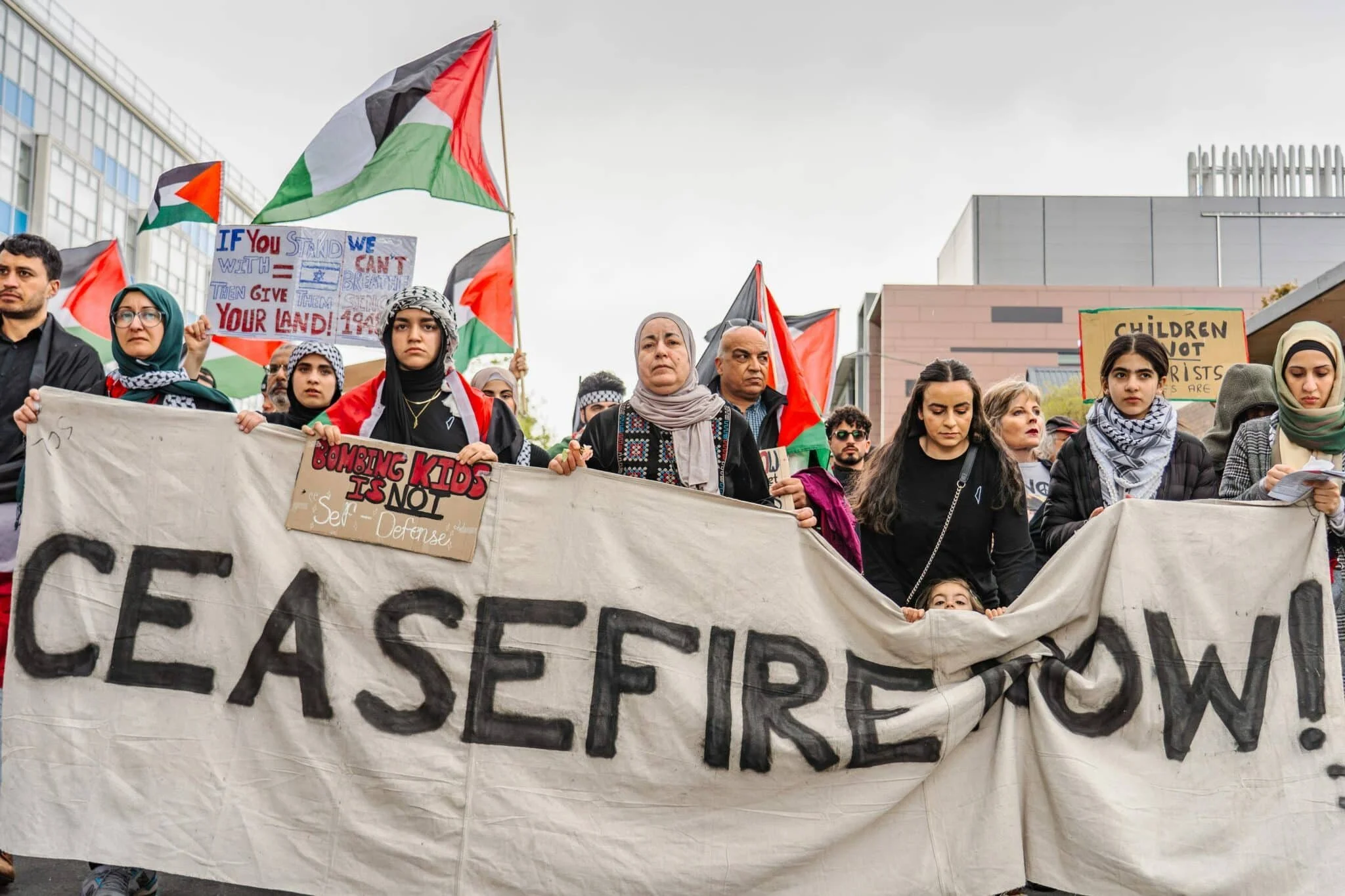
Protesters marching for a ceasefire on Mar 26, 2025
A ceasefire between Israel and Hamas took place on Friday, Oct. 10, marking the first sustained pause in fighting after two years of conflict in Gaza. Under the agreement, Israeli troops began withdrawing from sections of the Strip while both sides exchanged hostages and prisoners. Aid has also now begun to flow into Gaza in increased amounts, delivering essential supplies like food, water and cooking gas for the first time in months.
The Israel-Palestine conflict began in the aftermath of Israel’s establishment in 1948 and has been marked by wars, uprisings, and failed peace talks. In the decades that followed, Israel faced armed conflicts with the Palestinian Liberation Organization (PLO) and other factions of the Muslim Brotherhood. Hamas, an Islamist group designated as a terrorist organization by the United States, was founded in 1987 but came to power in 2007 after a violent civil war with Fatah, a Palestinian nationalist group.
On Oct. 7, 2023, Hamas launched a major, coordinated surprise attack from the Gaza Strip by land, sea and air. The incursion, which targeted innocent civilians, killed approximately 1200 people and took an additional 251 hostage, marking the beginning of the current Israel-Hamas conflict. Since then, two failed ceasefires have taken place in November of 2023 and March of 2025, the details of which included Hamas's demand for a permanent ceasefire and the full withdrawal of Israeli forces, repeatedly rejected by Israeli Prime Minister Benjamin Netanyahu.
The day after the deal was made, 20 Israeli prisoners were released from captivity in exchange for approximately 2,000 Palestinian prisoners and detainees. This number includes roughly 250 prisoners serving life sentences for serious crimes including terrorist attacks, and more than 1700 Palestinians who were detained in Gaza during the war and held without charge. An objective for Israel now involves the return of the bodies of the deceased hostages remaining in Gaza. As of Oct. 21, the bodies of 13 hostages are still being held in the Gaza Strip, buried under thousands of pounds of rubble, and some may not be located at all.
Alongside captive exchange, Israeli forces are under a partial withdrawal and redeployment to "agreed-upon deployment lines." Concurrently, Hamas combatants have redeployed to areas vacated by Israeli troops.
Following the ceasefire, tens of thousands of displaced Palestinians are currently returning to destroyed areas of Gaza, particularly in the north and Gaza City, only to find the areas largely reduced to rubble. In an interview with The Guardian, Gaza resident Abdel Fattah al-Kurdi described the stark difference between the city before the current conflict and what remains today.
“The city looks completely different, as if it is no longer the Gaza we once knew … Almost all of the houses are destroyed … the streets blocked,” Fattah al-Kurdi said.
The Hamas-run Gaza media office has stated that Israel has violated the ceasefire 47 times and killed 38 Palestinians. Israel has also kept the Rafah crossing (a major aid corridor) closed “until further notice,” citing Hamas-linked failures in the compromise. Palestinian authorities say this is an abuse of the ceasefire terms, since humanitarian access was supposed to increase under the ceasefire.
Hamas has also committed violations, including public executions of Palestinian civilians after claiming they had collaborated with Israel. On Oct. 19, the Israeli Defense Forces reported that two Israeli soldiers were killed in Rafah and accused Hamas of firing an anti-tank missile and gunfire, calling that an infringement on the peace deal.
The famine now gripping Gaza is widely described as man-made. This is partially the result of restrictions imposed by Israel on the entry and distribution of humanitarian aid during the war. Reports from the U.S. Agency for International Development have also accused Hamas of stealing aid and diverting relief supplies meant for civilians.
Despite the ceasefire, the humanitarian situation in Gaza remains critical, with aid groups warning that food, water, and medical supplies are still scarce. According to the United Nations Office for the Coordination of Humanitarian Affairs (OCHA), thousands of families are still sheltering in schools and in makeshift camps in the south.
OCHA has stated that aid delivery, while having somewhat improved, remains far below what is needed. By Oct. 13, about 949,000 meals had been delivered and water access had improved slightly, yet hospitals continued to function only in part or not at all. Fuel and sanitation systems are also severely damaged and whole neighborhoods are inaccessible due to debris and unexploded ordnance. Head of the Palestinian NGO’s network, Amjad Al-Shawa, told Al Jazeera that assistance remains insufficient.
“The aid that reaches Gaza goes directly to the most vulnerable families. But it remains insufficient. Almost everyone in Gaza now depends on humanitarian assistance after a full year of Israeli bombardment and siege,” Al-Shawa said.
Families of the hostages played a significant role earlier in shaping public pressure within Israel for a ceasefire and urging for the return of their loved ones. Their advocacy added urgency to the negotiations that followed.
The United States’ involvement in the peace deal has been central, as the Trump administration takes credit for facilitating talks between Israel and Hamas. The ceasefire was arranged and mediated by the United States, with Egypt and Qatar playing key roles in facilitating indirect talks between Israel and Hamas. Speaking to reporters aboard Air Force One, President Trump framed the agreement as a turning point in the conflict.
“Israel, with our help, has won all that they can by force of arms. Now, it's time to translate these victories against terrorists on the battlefield into the ultimate prize of peace and prosperity for the entire Middle East,” Trump said.
200 U.S. troops have also been deployed to Kiryat Gat, a city in southern Israel approximately 20 miles from Gaza. One anonymous senior White House official said in an interview with Reuters that no U.S. soldier would be permitted to enter Gaza as they were there to help prevent conflicts and establish a “joint control centre.”
Amid the political and military developments, Samo student and active Jewish community member Eli Tobel (’27) shared optimism about tensions beginning to ease and communities starting to heal.
“I mean, there's definitely been a lot of rise in antisemitism and Islamophobia. I really hope that the swelling of that stops. I mean, hopefully, now that the war is over, it’ll start to drop back down. Who really knows what the future holds?” Tobel said.