
The why, what, when and where of Prop 50
Art by Sara Polster
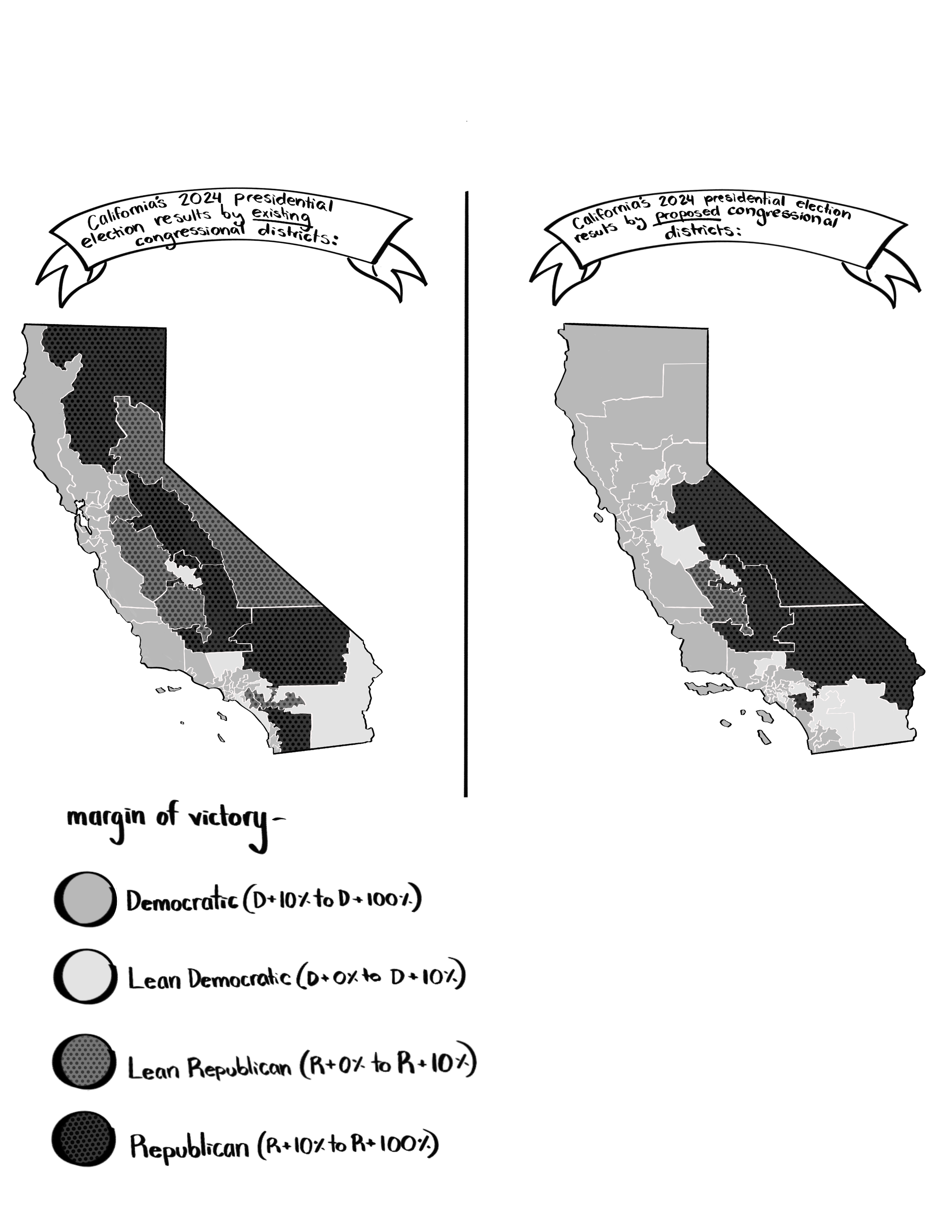
On Nov. 4, registered voters will go to the polls and vote on Proposition 50 (Prop. 50), formed by California Governor Gavin Newsom. Prop. 50 temporarily redistricts the state of California, switching five Republican districts Democratic. This was done in response to House Bill 4 (HB 4) in Texas, which flipped five Democratic districts Republican.
HB 4 allowed for a five-year early redrawing of the congressional maps in Texas. Traditionally, congressional maps are drawn every decade after a census is taken of the characteristics and quantitative size of citizens in each district. The census includes ethnicities, sexualities, economic status, genders and political parties. Once this census is taken, the maps are drawn and representatives are voted in within the district they reside in by eligible residents.
Currently, the House of Representatives has a split of 219 Republican seats to 214 Democratic seats, with a vacancy of two. HB 4 allocates five more Republican seats for the upcoming midterm elections by redrawing currently Democratic districts in Texas to have Republican majorities. For example, Austin, Texas, is currently split into two districts. With the proposed HB 4 maps, it is now concentrated into one district, decreasing the number of Representatives for this Democratic district by half. HB 4 would therefore give Republican representatives a numerical advantage in the House. Prop. 50 combats this addition by redrawing five currently Republican districts into Democratic districts on an interim basis, maintaining the current partisan ratio in the House until post-midterm elections.
Benjamin Schneer, a professor of public policy from Harvard Kennedy School, was interviewed on HB 4 by the Harvard Kennedy School Explainer. Schneer stated that the way in which Texas was redistricted is partisan involvement–in this case, gerrymandering–because of where they locate Democratic citizens within districts. Gerrymandering is manipulation of district boundaries to favor one political party over another.
“Another telltale sign of gerrymandering is a map with districts reaching into areas that tend to be suburban or rural… and then reaching into cities and picking out smaller numbers of Democratic voters in the cities,” Schneer said. “That’s known as cracking: taking voters from one party and moving them into a district where there are not enough of them to win in the district.”
HB 4 was put into place by Texas Governor Greg Abbott as a means to represent the large Republican population in the state. In approving HB 4, Governor Abbott mentioned this rationale for the bill and its importance.
"I congratulate… the Republican members of the Texas House of Representatives for passing congressional districts that better reflect the actual votes of Texans,” Abbott said.
Following this action by Governor Abbott, Governor Newsom responded with Prop. 50 to combat the new Republican representatives in Texas. Newsom also spoke of his belief that passivity in the Democratic Party needs to end.
“California will not sit idle as Trump and his Republican lapdogs shred our country’s democracy before our very eyes,” Newsom said. “This moment calls for urgency and action–that is what we are putting before voters this November, a chance to fight back against his anti-American ways.”
While many Democrats have supported Prop. 50 and felt that HB 4 gives Republicans an unfair advantage in the House, President Trump has argued to CNBC that the Republican Party deserves five more seats in the House.
“...we have an opportunity in Texas to pick up five seats–we have a really good governor [in Texas] and we have good people in Texas. And I won Texas–I got the highest vote in the history of Texas… so we are entitled to five more seats,” Trump said.
A Republican majority would likely benefit President Trump’s governmental agenda, as the representatives in the Republican Party have a greater chance of voting on laws in President Trump’s favor. Franklin Thomas (’27) shares that he feels the redistricting came directly from President Trump’s requests.
“I think [Texas] faced considerable pressure from the Trump administration just based off of his posts on social media,” Thomas said. “There is definitely a large amount of pressure from the Republican party to redistrict in order to get more seats.”
Prop. 50, if passed, would temporarily redraw California’s congressional maps in preparation for the midterm elections next year. HB 4 was passed through the Texas State Legislature without a vote from the general populace. The new maps, drawn out by the California State Legislature, are what California citizens will be voting on in Prop. 50.
The maps create larger districts in suburban areas. According to the Pew Research Center, a non-partisan organization, rural voters have developed from an about even split in 2000 to a 25 percent lead by the Republican Party in 2024. This means that a larger rural district, instead of the current, relatively smaller rural districts, would put more Republican Californian voters in the same few districts, giving them less power over the House, similarly to what was done in Texas to Democrats via HB 4.
As the election date is unusual for a statewide vote–given that it is happening in an odd-numbered year–voting-eligible students at Samo are able to participate in their government a year early. Shayl Khatod (’26) discussed his conflicting opinion on Newsom’s proposition.
“I honestly really dislike the legislation… people should have the power to define their own districts, but I’m also voting yes because everything’s so partisan right now,” Khatod said. “Morally it pains me but this legislation is important because it prevents Republicans from passing other great, big, beautiful, bad, terrible bills.”
He went on to emphasize that he hopes his fellow voting seniors will partake in the election.
“100,000 percent vote. Please vote. Yes, or no, or vote Republican, or Democrat. Yeah, just vote,” Khatod said.