
The development crisis in santa monica
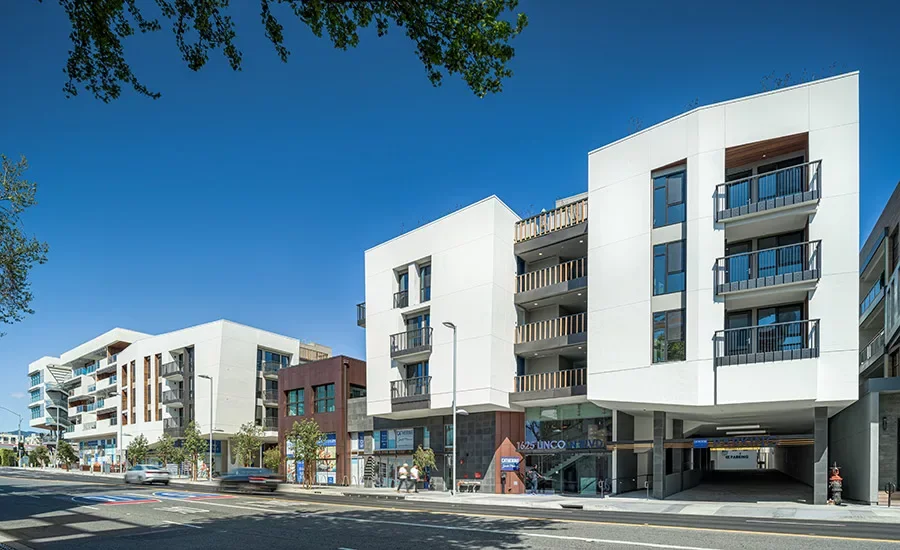
Carlos R. Hernandez / Engineering News Record
Newly constructed apartment buildings on Lincoln Boulevard between Olympic and Colorado.
As new buildings take over the streets of Santa Monica, it is now more urgent than ever to rethink the development of the city. With increasing frequency, multi-use high rises and apartment buildings are swallowing up entire blocks and dulling the city’s character. The charm of Santa Monica is fading at the hands of urban developers and something must be done before it is too late.
Cultural diversity is arguably the city’s most important characteristic and it is the foundation of its community and atmosphere. This diversity is what has allowed the city to incorporate variety in its architecture and create a distinctive built environment. However, on streets like Lincoln Boulevard, where multi-use high-rises have cropped up, diversity has been replaced with emptiness. Lacking any interesting embellishments or design choices, these buildings suck the life out of every street they are on. It is also apparent that they have created a dramatic disconnect in the city. Samo student Dae Bunuel (’27) has noticed this disconnect and reflected on its external effects on the city.
“I mainly grew up in a big city so I’m not a big fan of Santa Monica’s new in-between of having a small beach town and city vibe. I think that the big buildings are unappealing and can make the city look a little ugly,” Bunuel said.
As if the uninspired existence of high-rises in the city wasn’t enough, they tend to stretch across entire blocks, making streets feel uninviting. To have such big buildings is certainly an eye-sore, but it also requires large properties–properties that could have been used for buildings that serve civic purposes. This could range from recreation centers or parks to libraries or even local businesses.
With many of Santa Monica’s apartment buildings being considered affordable housing, they appear to benefit lower income families that reside in the city. But the promise of affordability has turned into a way for urban planners to fulfill city housing requirements, not living requirements. Residents may champion the luxury feel, stacked amenities and accessibility of such apartments. In reality, the sliver of units actually designated for low income housing are made with cheap materials, have awkward floorplans and are tucked away in undesirable parts of the building. Property owners almost always market their buildings as ‘luxury’, which, conveniently enough for them, distracts from the reality of thin walls and faux wood floors. Renters can easily fall for this and end up paying inflated prices for below-par homes. Affordable housing is unarguably vital to keeping the city alive and diverse, but it cannot become an excuse for developers to cut corners in quality. Samo student and athlete Misha Lakhani (’28) views the ‘luxury’ aspect of buildings unnecessary and unbeneficial.
“[Luxury] is a buzzword used to entice you, but it’s really just a high-rise building with a view. Granted, some have their perks, but I think it’s just much better to live in a space with more character,” Lakhani said.
What is astonishing about the city’s new construction projects is that there is hardly any middle ground between single family homes and monstrously large apartments. A happy medium of skinnier complexes would add street variety and build opportunities for local businesses and community centers. But instead of putting money towards projects that could more efficiently address the issue of housing affordability and aesthetics, the city has continuously approved of excessively large buildings that are often filled with vacant units.
Although much damage has been done, approaching new construction projects with a focus on design and habitability would help realign the city’s built environment. It would be a waste to let the uniqueness of Santa Monica be buried under the construction of massive buildings.