
Trump’s gross overstep of presidential power
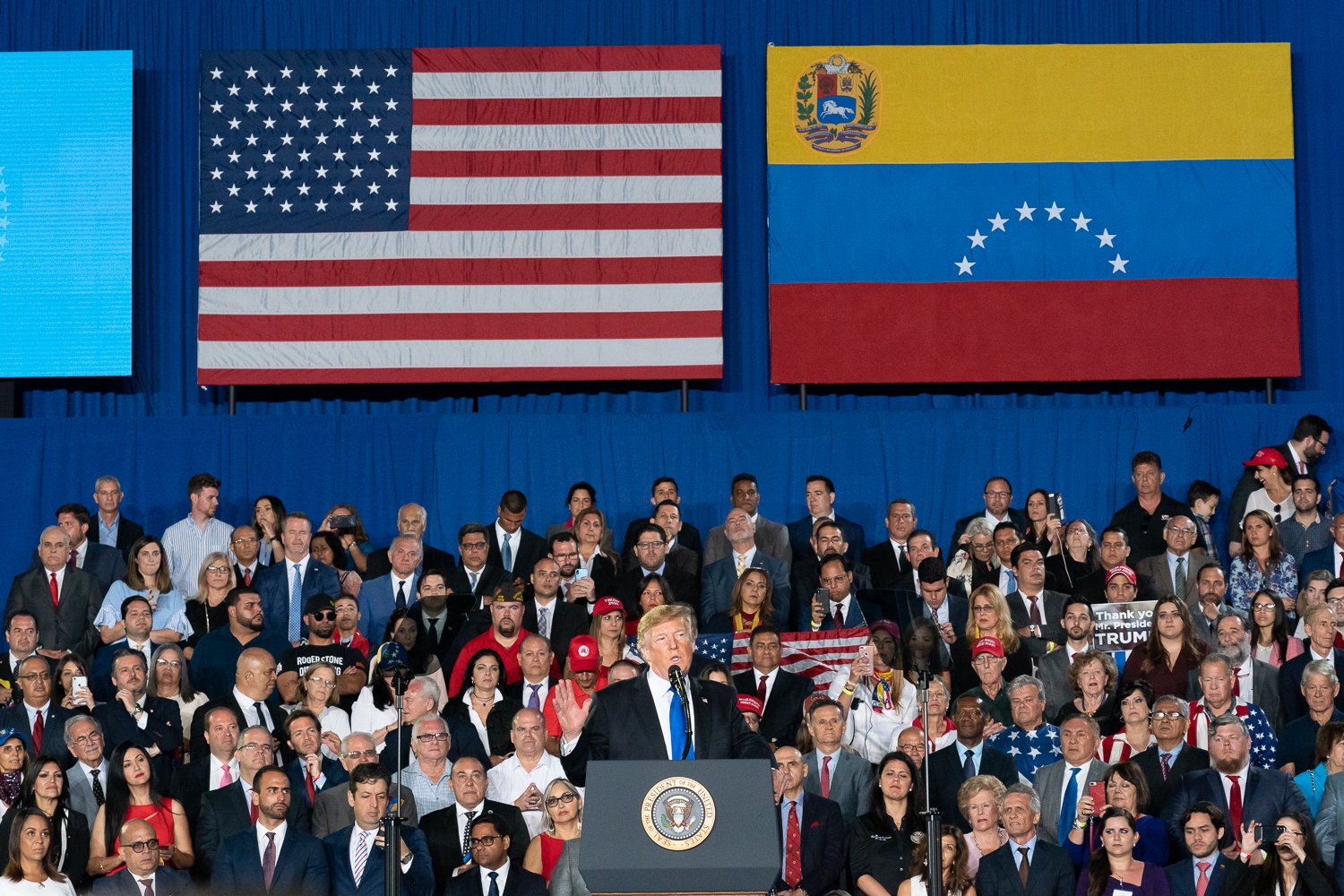
Andrea Hanks / Official White House Photo
President Donald J. Trump delivers remarks to the Venezuelan American community at the Florida International University Ocean Bank Convocation Center.
The United States has long called itself the defender of democracy, yet recently its actions suggest something far less noble. Under the Trump administration, foreign policy has increasingly become dependent on the president’s impulses, driven by personal ego, oil interests and economic leverage rather than law or principle. Military force has been used without any accountability, allies have been threatened for disagreeing and international norms have been treated as optional inconveniences. When the world’s most powerful nation rejects the very own rules it helped create, democracy is no longer the goal—it’s the excuse.
The first and most evident issue with the attack on Venezuela is the indifference towards international law. Under the United Nations Charter, military force against another country is solely permitted in cases of self-defence or with explicit U.N. authorization. Neither applied here. Contrary to our president’s claims, Venezuela posed no immediate threat to the United States and there most definitely were no international mandates approving unilateral military action.
Domestically, the administration’s actions were equally troubling. The president did not seek congressional approval before launching the operation and lawmakers from both parties later confirmed they were not notified in advance. As has happened before, Trump’s actions directly undermine the constitution, which grants Congress the exclusive power to declare war. That requirement exists to prevent a single individual from dragging the country into conflict based on personal judgement or political impulse.
This raises a rather large question: what happened to checks and balances? Isn’t that the entire point of our system of government? If the president can unilaterally decide when and where to use military force, congressional oversight becomes devalued. The abrupt expansion of presidential war powers has reached a dangerous imbalance, concentrating too much power into the executive branch and leaving the public with zero accountability.
Unfortunately, the consequences of this action extend far beyond Venezuela. When a country violates international law without consequence, it weakens the global framework designed precisely to prevent conflict. The idea that all states, especially the most powerful ones, are subject to the same laws forms the basis of international law.
If the United States can justify unilateral military action based on vague strategic or economic interests, what is stopping other countries from doing the same? China, for instance, could cite security concerns or regional stability as justification for an invasion of Taiwan. The distinction between lawful action and aggression virtually vanishes once legality becomes subjective.
Many Venezuelans expressed a feeling of relief in the immediate aftermath of Maduro’s removal. “Venezuela libre,” was chanted by crowds gathered in the streets and some described the moment as the best thing to have happened to the country in decades. After years of intense repression, corruption and economic collapse that reaction is more than understandable. Hope, even temporary hope, is powerful. That hope, however, has not translated into meaningful change. The new leadership remains closely tied to the previous regime, signaling continuity rather than real progress. The same political networks that sustained Maduro are still in place, making it both unlikely and difficult for genuine development to occur. So far, U.S. intervention has not produced any clear improvements in living conditions for ordinary Venezuelans. Although it’s only been a month, the country’s structural problems remain untouched and daily life looks largely the same for most people.
Supporters of the interference will argue that Trump and members of his administration, such as Marco Rubio, have stated that they plan to dismantle the remaining parts of Maduro’s management. That promise offers no guarantee beyond words. Throughout Trump’s presidency, he has time and again made bold asservations that were later walked back, contradicted or never fulfilled. There is little reason to assume this situation will be any different, in particular when his stated interests are concentrated on oil access and economic control rather than long-term institutional reform.
The Trump administration has repeatedly framed its intervention in Venezuela as an effort to promote freedom, often using humanitarian rhetoric to justify its actions. In reality, Venezuela's oil reserves are the central strategic focus behind the U.S. interest.
From the earliest statements after the hostilities, Trump highlighted control over Venezuela’s oil as a key part of his plan, asserting that the United States would manage their oil sales and revenue. This shift towards direct involvement in oil flows suggests that commercial leverage and market governance—not humanitarian aid—are driving policy.
Before the full military operation that captured Nicolás Maduro, the Trump administration launched a broader campaign, Operation Southern Spear, carrying out lethal strikes on vessels the U.S. government claimed were linked to drug trafficking. These strikes, which were authorized without advance congressional approval, expanded over months and became part of a larger military buildup in the Caribbean and eastern Pacific.
Critics have questioned the legal justification for using lethal force in this manner and whether adequate oversight took place, despite the administration's defense of the attacks as a counternarcotics effort. At least 126 people have reportedly died in strikes on alleged drug boats, including individuals whom lawsuits and rights groups say were civilians.
What ultimately unsettles me the most is how normal this has all begun to feel. Laws meant to restrain power are being brushed aside and decisions that affect innocent human beings are made without careful deliberation. Worst of all, the public is expected to accept it as necessary or inevitable. Foreign policy is not distant or abstract; it exposes what we are disposed to justify with power. Each time we look the other way, each time we normalize actions like these, we quietly lower the bar for what we are willing to accept.