
Trump Administration intervenes in Venezuela with seizure of President Maduro
On Jan. 3, President Donald Trump launched an attack-and-seizure of Venezuelan President Nicolàs Maduro in Caracas, the capital of Venezuela. Maduro’s wife, Cilia Flores, was also captured.
Tensions between Venezuela and the United States (U.S.) have been on the rise since former President Hugo Chavez came to power in 1999 but sparked up when Trump doubled the reward for capture on Maduro to $50 million and claimed that he had been working significantly with cartels to flood the U.S. with narcotics.
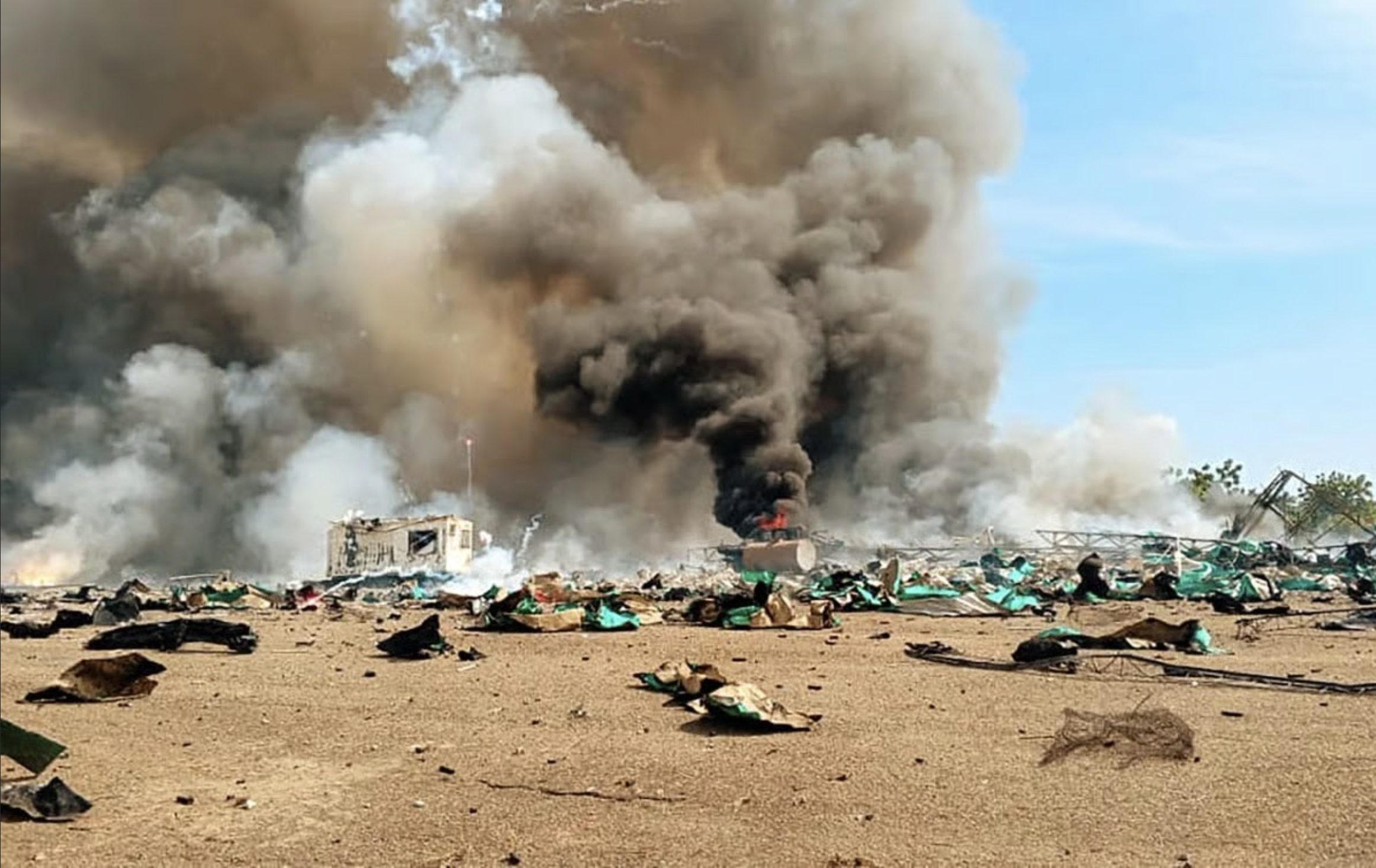
Bomb strikes in Caracas on Jan. 3.
Source: Agence France-Presse
After capturing Maduro, Trump promised to invest in the infrastructure in Venezuela to produce and sell more oil. On Jan. 14, he made his first oil sale of $500 million, which went to the funding of the Trump administration. Taylor Rogers, White House spokesperson, discussed the progression and priorities of the Trump administration within the Latin nation.
“President Trump’s team is facilitating positive, ongoing discussions with oil companies that are ready and willing to make unprecedented investments to restore Venezuela’s oil infrastructure,” Rogers said. “President Trump is protecting our Western Hemisphere from being taken advantage of by narcoterrorists, drug traffickers and foreign adversaries.”
Fact-checks have been conducted on the reliability of Trump’s reasoning that Maduro was supporting drug importation to the U.S., and the outcomes have shown that the cartel Trump cited–Cartel de los Soles–is not an actual cartel. Gustavo Petro, president of Columbia, called the accusation “the fictional excuse of the far right to bring down governments that do not obey them."
Verification networks have explained that the term “Cartel de los Soles” was coined in Venezuela in the 1990s to denote politicians that were involved in drug importation and corruption. Since this was brought to light, the Trump administration has redacted their statement and rephrased their claim to accuse Maduro of general drug importation, unassociated with any specific cartel.
However, Venezuela as a nation is heavily linked with drug production and exportation as a main source of profit. Thor Halvoressen, a famous Venezuelan dissident and founder of Human Rights Foundation, described Venezuela’s economic dependence on narcotics.
“Venezuela isn’t like Mexico, where a state coexists uneasily with cartels. Here, the cartel is the state. Factions–enriched generals, intelligence chiefs and narco-traffickers–won’t surrender power in a Washington-brokered deal,” Halvoressen said.
The action by the American president has also been met with outrage by some American citizens, some stating that these kinds of initiatives mimic imperialism. Trump has noted the Monroe Doctrine, an 1823 document labeling the U.S. as the overseer of the Western Hemisphere, as his primary justification for assuming control over the nation until a “proper and judicious transition” of power was possible. Angelina Cons-Santiago (’27) commented on the trend backwards in political strategy.
“The U.S. should definitely focus on itself because it already has enough problems that it should be devoting its time and attention towards,” Cons-Santiago said. “Not that international affairs aren’t important–they are–but there’s more that needs to be done within the U.S. rather than focusing on how they can make money from other countries.”
Others have also pointed out the possible economic and political benefits this investment brings. As the oil sale profits would fund the American government–which currently owes $38.4 trillion in debt–Venezuela could end up being extremely profitable for the country. Venezuela holds the largest oil reserves in the world but has been in a state of economic and political turmoil for several years. Before Venezuela laid claim to its own domestic oil, the United States controlled the profits via private companies. Because of this, many Americans have argued that the drastic cut of profit means that Venezuelan oil revenue should fund the U.S.
The capture of President Maduro also heavily impacted Venezuelan citizens, as many were unhappy with Maduro’s presidency. In 2024, Maduro lost the presidential election to candidate Edmundo González, proven through an electronic democratic vote, but remained in office as Venezuela’s National Electoral Council declared he had won. González was backed by the leader of the opposition to Maduro, María Corina Machado. Machado attempted to run for the Venezuelan presidency but was barred by Maduro’s administration. Machado has expressed that Maduro’s removal benefits Venezuela and its citizens.
"Faced with his refusal to accept a negotiated exit, the United States government has fulfilled its promise to uphold the law," Machado said. "We have fought for years, we have given everything, and it has been worth it. What had to happen is happening."
In 2025, Machado won the Nobel Peace Prize for her activism. After the capture of Maduro, she presented her award to Trump who called it “a wonderful gesture of mutual respect” and accepted the medal.
The Trump Administration has been unclear about the planned length of their hold on Venezuela. Secretary of State Marco Rubio stated that America plans to hold on to Venezuela until it is rebuilt.
“We’re not going to have this thing turn around overnight, but I think we’re making good and decent progress,” Rubio said. “We are certainly better off today in Venezuela than we were four weeks ago, and I think and hope and expect that we’ll be better off in three months and six months and nine months than we would have been had Maduro still been there.”