Government in Iran cracks down on anti-regime protests
In January, Iran experienced its most significant government crackdown since the Islamic Revolution in 1979, acting as a response to nationwide protests. Beginning as a movement against the country’s current economic state, the protesters’ intent shifted into a desire for an end to the current regime, led by Supreme Leader Ayatollah Ali Khamenei.
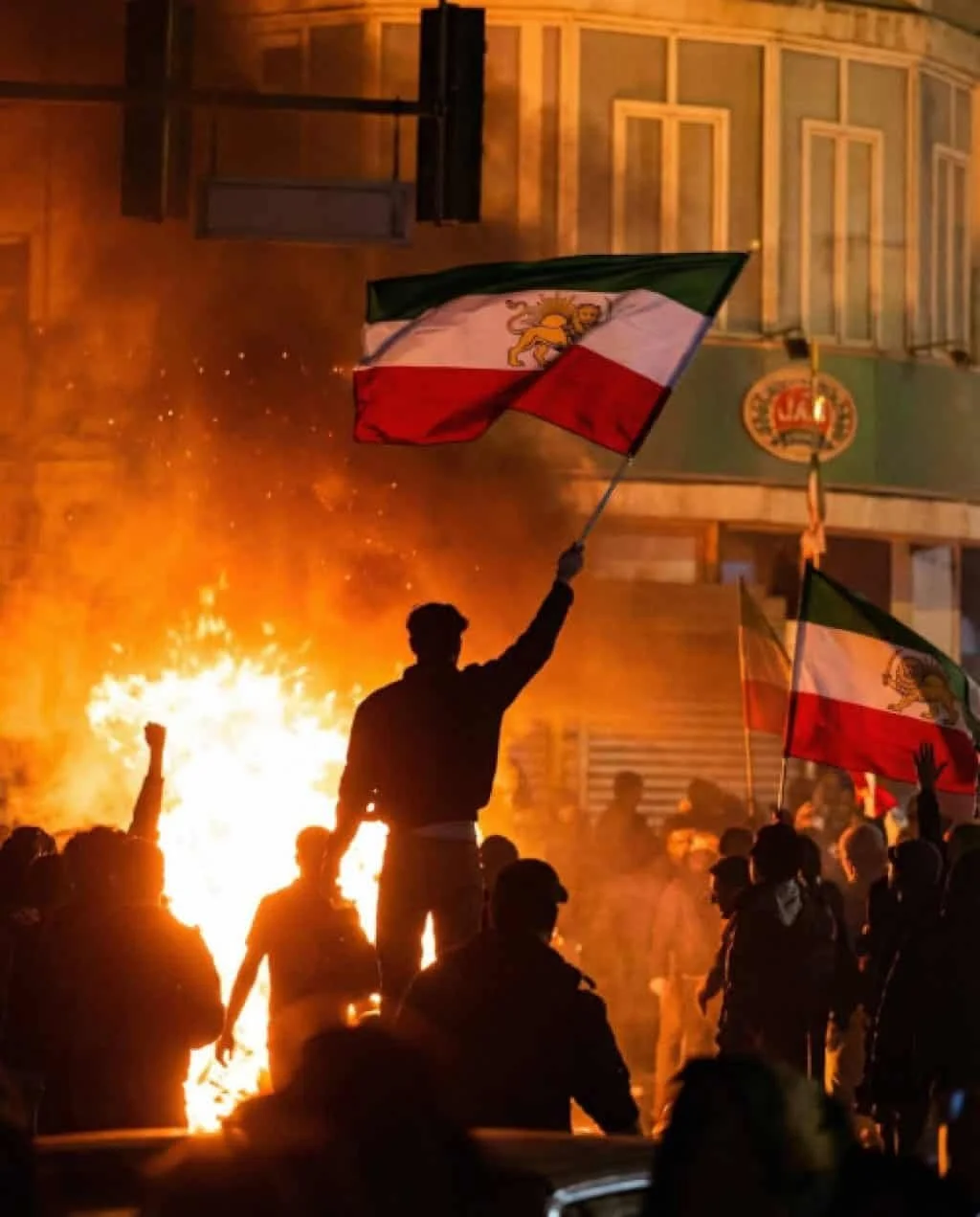
Wikimedia Commons / Contributor
Demonstrator waves Lion and Sun Flag during a protest in Tehran on Jan. 9
On Dec. 28 2025, various demonstrations across Iran rose in response to the collapse of the Iranian currency, the rial. This sparked frustration with shopkeepers and merchants, who were the first to demonstrate by closing their shops in Tehran’s Grand Bazaar.
This movement soon spread to each of Iran’s 31 provinces, with demonstrations in over 180 cities. These protests included anti-government slogans, such as the chanting of “Death to the Dictator,” referring to Khamenei.
One Samo student was in Iran visiting family at the same time as the ongoing protests. This student explained the atmosphere they felt in Iran during the time they were there. The student wished to remain anonymous out of fear for their family’s safety in Iran.
“People had a lot of pressure on them from inflation. At the same time, you could also feel that everyone was angry,” the student said.
On Jan. 8, the government responded to these protests by cutting off internet access and telephone services, in an attempt to inhibit the organization of the protesters. Some Iranians were able to make calls outside of the country, but it was not possible to call into Iran.
In response to communications being cut, exiled prince of Iran, Reza Pahlavi, called on President Donald Trump to intervene with the current situation in Iran. The reason for Pahlavi’s exile is due to the Islamic Revolution (1979) that overthrew Pahlavi’s father and led to the establishment of the Islamic Republic. Pahlavi left the country during his father’s overthrow, and has not returned since. Pahlavi has remained an advocate for democracy in Iran.
"Mr. President, this is an urgent and immediate call for your attention, support, and action. Last night you saw the millions of brave Iranians in the streets facing down live bullets. Today, they are facing not just bullets but a total communications blackout. No Internet. No landlines," Pahlavi wrote on X.
Due to this blackout, the number of deaths is speculative and has not yet been confirmed. On Jan. 21, Iranian state TV announced the first official death toll, saying 3,117 protesters had been killed. According to Time magazine, two unnamed officials in Iran’s Ministry of Health reported that the toll was upwards of 30,000 on Jan. 25. Time has not been able to independently confirm these figures. The U.S.-based Human Rights Activists News Agency also reports that more than 42,450 have been arrested as of Jan. 28.
Nagmeh Wagner described her experience living as a young Jewish girl in Iran who had been born the day Khamenei assumed power. Wagner left Iran when she was 10 years old, and is now a special education teacher at Samo.
“It wasn’t fun…obviously being a girl in a country ruled by Islamic extremists. And it's under Sharia law,” Wagner said.
Wagner went on to describe the experience she went through for not wearing a hijab, such as when a car hit her when she was three years old. She views experiences like her own as pushing many Iranians to rise against the regime.
“They burned 86 mosques during this protest. What do you think this means? They’re going against the religion itself because they're saying we don’t want religion to govern us as a country. So they burned [them],” Wagner said.
The Islamic Republic has branded these protesters as ‘terrorists’ for the mosques that have been deliberately targeted amid the protests.
These protests are among the many since Khamenei’s assumption of power during the Islamic Revolution in 1979, when Shah Mohammad Reza Pahlavi’s monarchy was overthrown. Since this time, various protests have occurred, driven by dissatisfaction with the current ruling theocratic regime, whose laws are guided by Islamic principles. This includes the “Bloody November” protests when fuel prices rose in 2019 as well as the “Women, Life, Freedom” movement in 2022 after the death of Mahsa Amini. These protests stimulated anti-regime voices, which resulted in crackdowns from the Iranian government.
“I do think it's different from the other protests. Even the ‘Women, Life, Freedom’ one, when Mahsa Amini was killed. That one, it was more about the female, about the women…This time, and with Iran, if you know the history of Iran, you know that the Revolution started with the merchants. If the merchants are not in it, you don’t have a revolution. All you have is a protest,” Wagner said.
Iran’s persisting economic problems can be seen as the product of sanctions imposed by the United Nations (UN), the United States (US) and the European Union (EU). These sanctions have cut off Iran from important sources of revenue, such as oil exports and restricted their access to global markets. The price of basic necessities rose to compensate for this loss of profit, leading to inflation and a depreciating value of the Iranian currency.
Along with the sanctions, other factors that have contributed to the economic situation include mismanagement of public resources, leading to the deterioration of energy facilities. According to the Global Initiative Against Transnational Organized Crime, oil is smuggled out of Iran and into neighboring countries, where the fuel can be sold for higher profit margins. The reduction of domestic energy leads to shortages and an estimated yearly loss of the equivalent of tens of billions of U.S. dollars.
Iran currently faces a severe water crisis, where reservoir supply to Tehran has dropped to 8 percent of its capacity. Driven by climate change, drought and the mismanagement of agricultural practices, these water shortages have created the risk of the city running out of water and potential evacuations at the command of President Masoud Pezeshkian.
Trump and his national security team have been looking at options on how to intervene against Iran. On Jan. 11, Trump told reporters on Air Force One that the nation is looking into solutions.
“The military is looking at it, and we’re looking at some very strong options,” Trump said.
Before taking any immediate action, Trump imposed a 25 percent tariff on countries that engage in trade with Iran, including Brazil, China and Russia.
On Jan. 16, Trump thanked the Iranian government for halting the execution of hundreds of protesters. This attitude followed Trump’s suggestions of military intervention if mass government killings were triggered.
On Jan. 17, Khamenei addressed the number of deceased protesters in a televised broadcast from Tehran. In this broadcast, Khamanei explained that the deaths in Iran were the fault of foreign agents, not state officials from Iran.
“We consider the U.S. president criminal for the casualties, damages, and slander he inflicted on the Iranian nation,” Khamenei said, according to Iranian state media.
Home to the largest Iranian population outside of Iran, many protests have taken place in Los Angeles in favor of the change in Iran’s current regime. The majority of these protests have taken place in Westwood, commonly as ‘Tehrangeles’.
As of late, military tensions with the U.S. and Iran have escalated, as the United States Ship Abraham Lincoln was deployed to the Middle East. Following a discussion between Washington and Tehran regarding Iran’s nuclear programs, Trump is considering airstrikes against leaders and government institutions. Nuclear talks are expected to continue in a meeting in Istanbul on Feb 6.
On Feb. 3, the U.S military shot down an Iranian drone in the Arabian Sea. The Iranian Shahed-139 drone was flying toward the USS Lincoln with “unclear intent”, the US military said to Reuters. As these discussions are yet to occur, the future of Iran is left uncertain.
“My dad said there’s no color darker than black. And right now, he thinks that the current regime and the situation in Iran is black… It’s like the worst that it could be,” the anonymous student said.