
California governor candidate Swalwell drops out amidst allegations
On April 12, Former Democratic United States
(U.S.) Representative Eric Swalwell dropped out
of the California gubernatorial race amidst sexual
assault allegations.
The allegations surfaced on April 10 when me-
dia outlets Cable News Network (CNN) and The
San Francisco Chronicle published stories, which
included sexual misconduct allegations testimonies
from four women, one from a former staff mem-
ber. In a statement issued to the San Francisco
Chronicle, Swalwell responded to the allegations
by describing them as “false” and “lies”.
Following his withdrawal from the race, Swalwell
officially resigned from his position as U.S. Repre-
sentative for California’s 14th Congressional Dis-
trict on April 14. Swalwell served in the House of
Representatives since 2013, where he represented
the 14th District for 10 years and the 15th District
for the last three years. Swalwell’s policies focused
on gun violence prevention, accessible health-care
and reducing student loan debt.
Mae Thouvard (’26) explained how Swalwell
appealed to younger groups of voters through the
policies he promoted.
“Young people voted for him because of the stu-
dent loan policies that he was trying to establish,”
Thourvard said.
Prior to his withdrawal, Swalwell held a prom-
inent position in the race. According to the larg-
est prediction platforms for political gambling,
Polymarket and Kalshi, Swalwell was the favoured
Democrat candidate and most likely to succeed in
the primary round. Reflected on Kalshi, Swalwell’s
odds were constantly above 50 percent. Swalwell’s
odds dipped to 41 percent on April 9 after the
circulation of allegations began on social media.
Within hours of the release of the published stories
from the Chronicle and CNN, his odds dropped to
around one percent.
Archie Windsor (’26) explains how Swalwell’s
withdrawal has affected the overall political land-
scape around the race.
“I think it was significant because he was kind of
the leading candidate. So now all of his voters obvi-
ously have to go elsewhere to Tom Steyer, Becerra,
Mahan,” Windsor said.
From April 30 to May 2, a poll was conducted
by the California Democratic Party. It found that
Republican Steve Hilton and Democrat Xavier
Becerra were tied for first place, each with 18 per-
cent of the likely voter support. Trailing behind
these candidates was Chad Bianco with 15 percent
of the vote, Tom Steyer holding 12 percent of the
vote and Katie Porter with nine percent of the vote.
13 percent of the voters are considered undecided,
compared to the 23 percent of voters who were
undecided in a poll taken on Apr. 14 by Emerson
College, showing a growing trend in decisiveness
towards placing a vote as the primary election nears on June 2.
Thouvard explains how she thinks previous Swalwell supporters will redirect
their support.
“I don’t think it’s going to change much about their views. They’ll just
go to the next front runner of the Democratic party, because no
matter what [Swalwell] did, they still believe what
they believe. And if the next person is going to use
similar policies or ideas, people are still going to get
behind them,” Thouvard said.
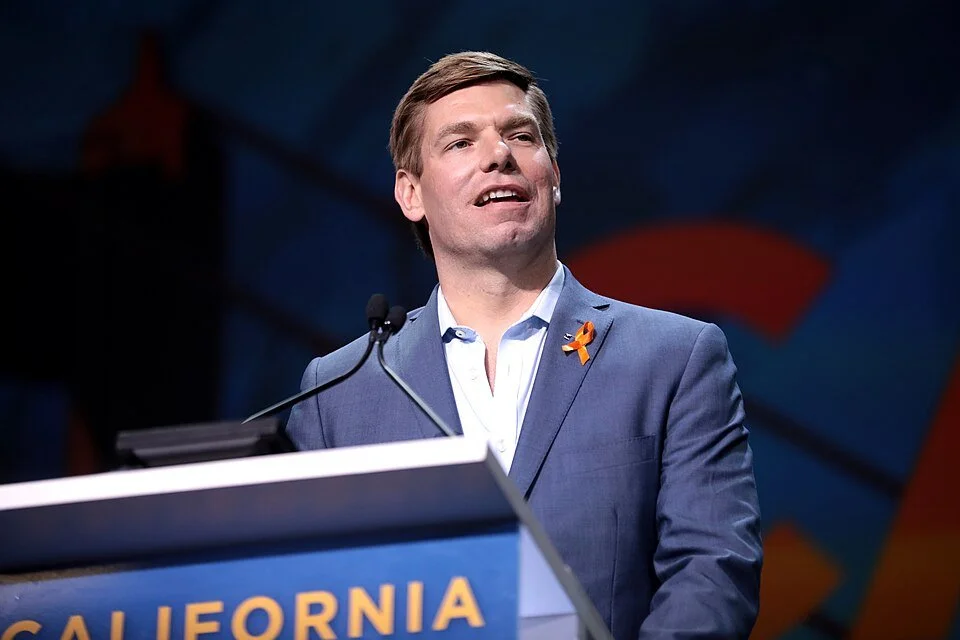
Gage Skidmore // Contributor
U.S. Congressman Eric Swalwell speaking with attendees at the 2019 California Democratic Party State Convention in San Francisco, California.