
Investigation of Cesar Chavez uncovers sexual assault
In March 2026, the public legacy of labor organizer Cesar Chavez was tarnished after a major investigation by The New York Times reported allegations from multiple women who said Chavez sexually assaulted or abused them during the height of the farmworker movement in the late 1900s. According to reports from multiple news outlets, the accusations came from three women, two of whom were minors at the time and were connected to families involved in the farmworker movement. The women alleged that Chavez used his status as the face of the movement and as president of the United Farm Workers (UFW) to isolate and assault them during organizing trips, meetings and stays at union compounds.
The allegations escalated further when fellow labor icon Delores Huerta, who co-founded the UFW alongside Chavez, publicly stated that Chavez had sexually assaulted her on two occasions.
“As a young mother in the 1960s, I experienced two separate sexual encounters with Cesar. The first time I was manipulated and pressured into having sex with him and I didn’t feel I could say no because he was someone that I admired, my boss and the leader of the movement I had already devoted years of my life to,” Huerta said. “The second time I was forced, against my will and in an environment where I felt trapped.”
Huerta went on to say that she had gotten pregnant from both of the incidents and had quietly arranged for the children to go to other families. Her statement dramatically shifted the public response, turning what had initially been viewed by some as unverifiable allegations into a broader reckoning over one of California’s most celebrated civil rights figures. Without hours of Huerta’s statement, organizations that had long preserved Chavez’s image began distancing themselves from him. Both the UFW and the Cesar Chavez Foundation announced they would cancel or withdraw from annual celebrations honoring Chavez and acknowledged the allegations as incompatible with the values of the movement.
The fallout in California was immediately and unusually swift. Democratic leaders in Sacramento introduced legislation to rename the state holiday formerly known as Cesar Chavez Day to Farmworkers Day, shifting the focus away from Chavez as an individual and toward agricultural workers as a whole. Governor Gavin Newsom publicly signaled support for the proposal, making one of the most visible state-level breaks from Chavez’s legacy since his death in 1993. By late March, state officials were also discussing removing Chavez from the California Hall of Fame, where he had been part of the inaugural class.
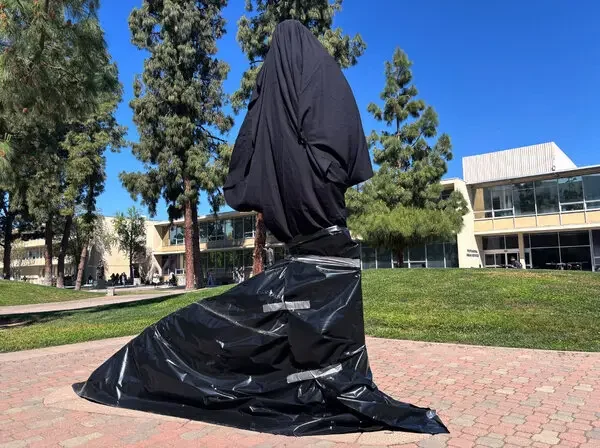
Local governments across California began acting even faster. In San Fernando, city workers removed a statue of Chavez and covered nearby murals only days after the victims’ stories were made public. In San Diego, Mayor Todd Gloria signed an executive order directing city departments to remove Chavez’s name from public facilities, programs, streets and community centers. The city also began the process of replacing Cesar Chavez Day with Farmworkers Day in municipal code. In Los Angeles, city leaders and school officials announced similar efforts, with both city departments and school boards reviewing campuses, libraries and public spaces bearing Chavez’s name.
Samo’s Human Rights Watch Student Task Force club co-president Maya Munoz (’27) who also attended the Dolores Huerta Foundation’s Camp commented on how schools can manage situations like this in a way that’s honest and educational.
“I’d heard prior things about the kind of person he was… [at camp]. I was actually able to meet Huerta and have some conversations with her so I was really surprised and felt really sad that she felt like she had to hide it for this long,” Munoz said. “I think schools have the responsibility to educate students on both the triumphs of Chavez and his faults because it’s important to give students a complex way of viewing things.”
Universities and school districts also began reconsidering decades of memorialization. Campuses across the state, including institutions in San Diego and the Central Valley, started removing statues, plaques and campus memorials dedicated to Chavez. Several K-12 districts announced reviews of schools named after him, while colleges nationwide like University of Arizona began discussing permanent building renaming efforts. Ana Avendano, in an article published by the Women’s Media Center, reflected on how inequalities and violations like this can arise in organizations.
“Accountability requires that the movement as a whole answer the questions it has consistently refused to answer: What made this possible? Who knew? Who enabled the conduct? What structural conditions have allowed behavior like this to persist across decades?” Avenado said.
“Answering those questions honestly would require the labor movement to turn its most powerful tools on itself.”
Bryon Solorio / FOX26
Statue of Chavez located at Fresno State University is covered days after the investigation.