
The Samohi’s scoop on the City of Santa Monica versus Waymo
On April 22, Waymo and the City of Santa Monica met at the Santa Monica Courthouse for the newest hearing in the city’s ongoing lawsuit against the autonomous driving technology company. In this hearing, Waymo requested to delay a preliminary injunction filed by the city that would require Waymo, in the months leading up to the trial, to shut down the activity in their charging lots from 11 p.m. to 6 a.m. Waymo’s legal counsel argued that they needed more time for discovery (the pre-trial period in which evidence is collected). The hearing delayed the date of the preliminary injunction to July 10 and set up a scheduled status conference for this meeting on May 18.
In the hearing, Waymo asserted that they have evidence that the city’s main witnesses were engaged in a combined effort to physically disrupt Waymo’s activities, in what they argue directly caused the disturbances that initiated the ongoing legal conflict between Waymo and the city. The city strongly disputes Waymo’s claim.
In Nov. 2024, Waymo moved into two lots on 1222 and 1310 Broadway that previously belonged to nearby Ford dealerships. The lots are owned by SMF properties and were rented out to the tenant Voltera which operates the charging equipment. These lots are located beside multiple apartment complexes; the residents of which have filed numerous complaints since the lots became operational. The autonomous vehicles, in their path to the lots, are rerouted through the alley adjacent to these apartments. Their activity is 24-hour and reports from residents have demonstrated that upwards of 300 vehicles pass through their neighborhood daily. Neighbors complain that this has created a constant nuisance, with disturbances including beeping, strobe lights and other sound pollution from the vehicles and activity on the lots.
The Samohi went to the Waymo lots on 1222 and 1310 Broadway, to receive comments from employees who worked there. However, all employees were unwilling to speak, with the answer most commonly received being that the employees are legally prohibited to speak to anyone from the press or public due to an NDA.
Dylan Moore, a witness to the city, gave his description of Waymo’s activity.
“There are a lot of cars that will beep as they back up into those spots or back out of them, or need to back up if there’s an obstruction in the road and it has a very loud and distinctive reverse sound. This happens all day long, all hours of the day,” Moore said.
In response to the complaints, the City of Santa Monica entered into negotiations with Waymo to try and find a workable solution to the residents’ issues. Waymo initially made concessions: stopping the beeping of vehicles as they autonomously backed into parking spaces within the lot, reducing light from the lot and rerouting vehicles through alleys instead of city streets (a request made by the city to reduce traffic, which they later reversed after the disturbances).
Romy Ganschow, Santa Monica’s chief deputy city attorney for the Consumer Protection Division, is currently representing the city’s lawsuit against Waymo. She claims that Waymo was offered various alternatives before what eventually became legal action.
“There was a meeting that we had in October with higher level city officials and Waymo and Voltera and the property owners. And during that meeting, we said, what can you do about overnight operations? We didn’t really hear from Waymo or Voltera for about a month after that. And then at that point, we said, we’re going to require you to shut down overnight because you’ve not really offered anything else,” Ganschow said.
“Then they did respond... They requested that we have some time to come up with some other solutions. The city responded and said, if you can’t shut down overnight, then can you do this list of about eight or ten things... and if you do all of those things taken at once, that might have a good impact. It’s not shutting down, but it’s recirculating the cars so they’re not going through the alleys at night,” Ganschow said. “It’s having them not just circulate in the immediate neighborhood, so it’s going past the same people’s windows over and over and over again. And they said that effectively making the cars circulate more broadly, ‘that is too burdensome for us.’”
On Nov. 19, the City of Santa Monica filed a cease and desist order demanding Waymo stop overnight charging operations. On Dec. 17, Waymo sued to stop this order. On Dec. 24, the City of Santa Monica filed its own lawsuit declaring Waymo’s charging stations a “public nuisance”.
Waymo, in its lawsuit, pointed out the aforementioned compromises they had made.
In Waymo’s documents, a complaint for deceleration and injunctive relief, Waymo responded to the cities concerns.
“These changes resulted in a material decrease in noise and light levels during Waymo’s overnight operations and traffic congestion in the surrounding areas was reduced.’’
In an official statement, Waymo decried what they see as an “adversarial” approach by the city.
“Waymo has demonstrated a consistent commitment to being a good neighbor, including by consulting with regulators to mitigate noise concerns - an effort the City itself acknowledged as successful. However, the City has been unwilling to authorize simple improvements to respond to neighbors’ feedback and now objects to use of the public alleyway their own Department of Transportation asked us to use. We are disappointed that the City has chosen an adversarial path over a collaborative one. Waymo and Voltera remain in full compliance with all local requirements and will continue our operations accordingly.”
Forefront of the city’s lawsuit are its declarants: 12 residents who are claiming that Waymo’s activity has become a consistent negative impact on their daily lives. In reality there are over 25 people who are directly impacted by the Waymos. Many of these residents, such as Moore, have been active in protesting Waymo’s presence in their neighborhood. Moore in his blog, Waymoproblems.org has been active in documenting his and his neighbors issue with the company.
“There’s something that we’ve all had to come together to fight against. We have unfortunately, this trauma bond of being woken up,” Moore said. “It’s pervasive if you just go away from this neighborhood and you just hear a Waymo driving, it snaps you in this weird trauma place where it’s like you’ve been hearing it all the time and now you’re away from home and you’re still hearing it. This has just fundamentally changed our psyche, where you don’t really exactly feel safe, because these things are everywhere now.”
Waymo’s legal counsel, with heavy dissent from the city and its witnesses, has asserted that these declarants have gone beyond common protest and are part of a concerted effort to physically disrupt their operations through various methods, most notably what has been termed “stacking”: the process of intentionally queuing vehicles. Waymo claims that “stacking”, rather than their own processes, have caused a significant portion of the alley congestion and noise issues that have been complained about. Chief in their evidence is a group chat called the “stacking committee” which many declarants had been a member of (though only one has been reliably proven to have engaged in “stacking”). This “stacking” has led to at least one physical altercation between lot employees and the one resident.
Nancy Taylor, a longtime Santa Monica resident living adjacent to the charging stations has noted altercations that occurred.
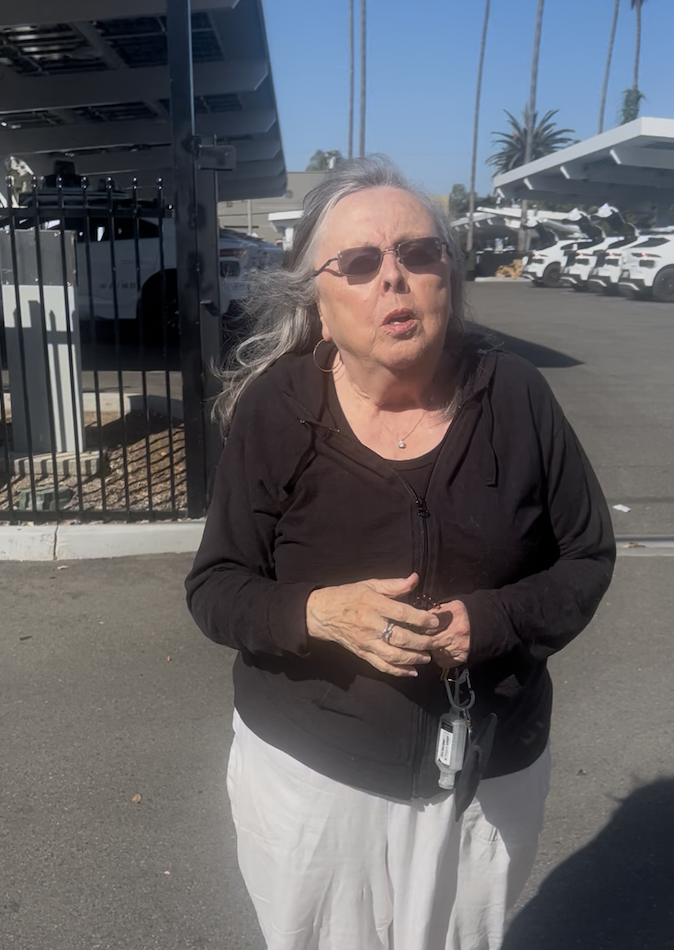
Nancy Taylor, one of the City’s declerants stands in front of the Waymo Lot on 1222 Broadway
Leo Mooney/Contributer
“A neighbor took cones and wouldn’t let the Waymos out. The worker came out and moved cones and then the neighbor went out, movedthem back and then a physical altercation happened. Not a fist fight, but they were hitting each other and arming each other,” Taylor said.
In March of 2025, a year prior to the current legal proceedings, Waymo filed a lawsuit against a local activist, referred to commonly by the pseudonym “Stacker One”. Stacker One started the idea of “stacking” Waymo vehicles and was subsequently sued by the company. He explained his motivations and methods for his protest.
“By late January... the city took no action. That’s when I began what is called stacking the most. The great thing about the Waymo is that they have no driver and they’re programmed pretty well to not run you over. I could just stand in front or walk really slowly at the far end of the alley, where there’s no people and no buildings and no apartments,” Stacker One said. “My goal was to do anything that could somehow cause Waymo to stop operating from 11 p.m. t0 6 a.m.”
Stacker One also claimed that his actions were the actual precipice for the current legal conflict Waymo is entangled in.
“How did we get from three or four months of nobody in the world caring about this violation of the law? Waymo was doing its thing and had no problem whatsoever. They did it to themselves.”
Following Waymo’s lawsuit against Stacker One, the LA Times along with a number of publications picked up the story, bringing it to the forefront of the news media.
On April 19, the city’s declarants were issued a subpoena by the court at the behest of Waymo’s legal team. The subpoena is broad and seeks to find things relating to communications with the City of Santa Monica, communications with the Santa Monica Police Department, complaints regarding Waymo’s operations, communications with unions, advocacy groups, coalitions, or third parties, photos, videos, or recordings involving Waymo, documents related to “stacking” and documents about efforts to slow down or block Waymo vehicles.
Taylor, like many of her other fellow declarants, shares the sentiment that the subpoenas have gone too far.
“The subpoena is very invasive. I spent about 16 hours working on it because it’s really difficult. I’m a witness to this case, but I feel like I’m being treated like a criminal. It’s very distressing and I’m taking the subpoena seriously and I will do it. But I don’t think it was warranted,” Taylor said.
Ganschow also believes that Waymo’s course of action in the case has been irrational.
“Waymo has chosen to respond to this lawsuit by blaming the victims. By saying they’re the ones causing the problems, that a good portion of them have manufactured the problem. I don’t think there’s evidence of that. I mean, it’s one thing to take that position and it’s another thing to take that position when there’s no evidence of it,” Ganschow said. “It’s our position that they mischaracterized, selectively took people’s words out of context, and really misrepresented what people were talking about in their text messages. We pointed out to them how they were misrepresenting what the evidence showed, but they have persisted in doing that. And that’s concerning.”
Moore believes that this is an intentional tactic from Waymo’s legal team.
“The lawyers are doing something called lawfare, where they’re weaponizing the law system to intimidate witnesses. One of the witnesses for the city just here today told us that she regrets ever doing this, and that’s the point of doing something like this,” Moore said. “The Waymo lawyers don’t actually think that there’s going to be something that they’re going to gain from more discovery. It’s deterrence. It’s deterrence to make us either withdraw our statements or to not want to cooperate with the city, in my opinion.”
The Samohi reached out to Waymo’s counsel for comment, but were told to contact Waymo’s press office instead. No response has been made as of yet. Additionally, The Samohi reached out to a consultant from Voltera at a meeting on May 13, but the consultant was also unable to give the The Samohi comment.
Moore, like all of the other witnesses, remains lawyerless. Most are unable to afford legal representatives and as declarants, lawyers are not automatically provided to them. Moore and his fellow neighbors are, thus, self-advocates. Notably, he spoke in front of city hall, in a speech that prompted a reaction from new Santa Monica City Manager Oliver Chi.
“He heard me speak in City Hall before I’d left the building, he’d gotten my email from a council member and set up a meeting. So I have nothing but flowers to give to our new city manager for the effort that he’s put in on this. A lot of credit is due to City Manager Chi for what he has done,” Moore said.
On July 14, 2025, Chi officially became the Santa Monica City Manager, which marked the fifth in the last five years. He has been a central figure in Santa Monica’s ongoing legal battle. When Waymo filed its lawsuit on December 17, 2025, Chi filed the city’s countersuit.
While Moore is very grateful to the city for its work, he claims Waymo should have never been permitted to occupy the lot they are currently in. Under California Assembly Bill 970, certain areas including Waymo’s lots were designated as EV Charging Stations. Moore claims that Waymo should be classified as “light fleet operations” and under the zoning aspects of the law, should never have been permitted by the city to set up their parking lots in these locations.
“I’m going to be following up with the city for lessons learned in the way that the permitting system worked and what AB 970 grants you and what it doesn’t, because I feel like this part was a failure of the city,” Moore said.
This legal interpretation however, is not verified and is contested by Waymo.
If the preliminary injunction passes on July 10, Waymo will be forced to halt their overnight operations until the issue is further adjudicated by the Los Angeles Court Superior Court. The trial will not only impact Waymo’s local activity in Santa Monica, but could become future precedent for emerging technologies and their continuing role in modern American communities.
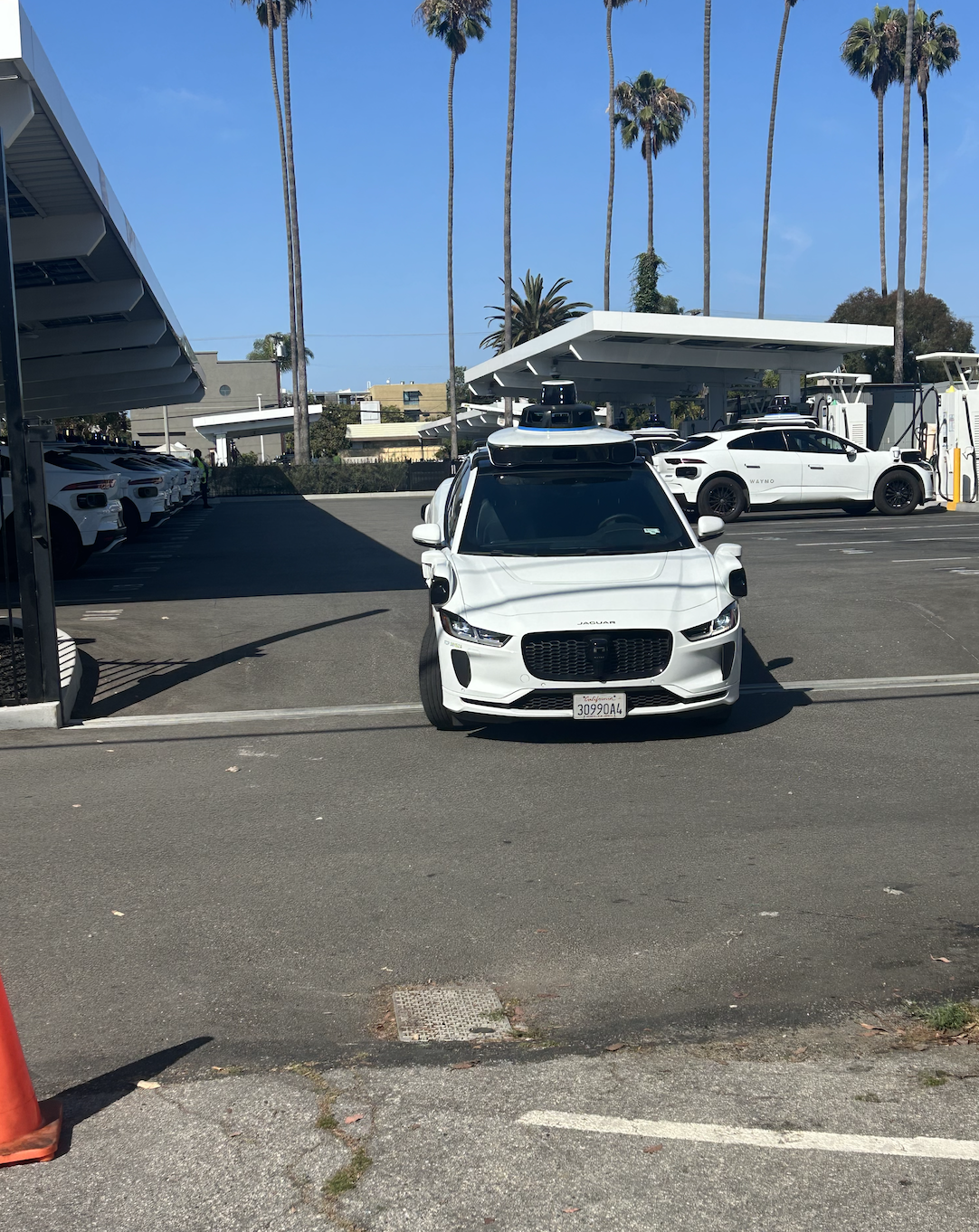
A Waymo pulls out of the lot on 1222 Broadway
Leo Mooney/Contributer