
School Threats: how samo responds (Copy)
Otem Free / The Samohi
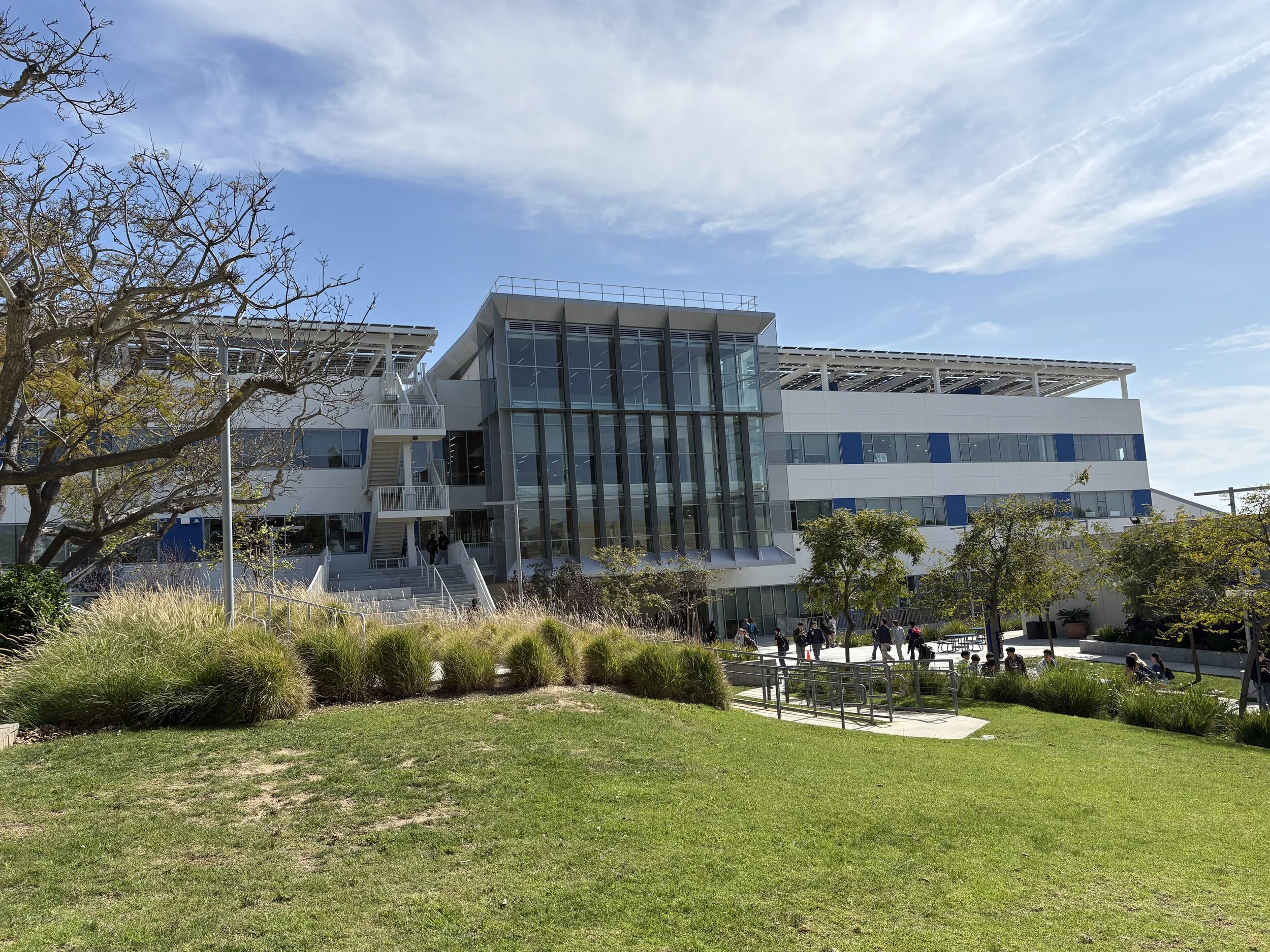
The Exploration Building features glass throughout its design, alongside designated safe spaces.
On Jan. 25, Samo students received an email from the school about a bomb threat that was called into the school during that day. The bomb threat, sent from a computer-generated voicemail, declared that bombs planted in the school were set to go off during Monday classes the next day. Soon after the threat was called in, the Santa Monica Police Department (SMPD) responded by searching the school, utilizing a drone, a bomb sniffing dog and police searchers, according to KTLA. After a comprehensive sweep was done, the incident was given the ‘all-clear’ by the SMPD, and Samo students were allowed to come back to campus for classes the next day.
However, not all Samo students were comfortable returning to school. Erik Wichman (’28) spoke about how he felt nervous about returning to campus on the day following the bomb threat.
“Still, it makes me feel good that the school went out and told people about the threat, but it was
the fact that there was a bomb threat at the school that made me a bit worried. I think Samo is pretty well secured, but then again, never say never.”
Samo Principal Marae Cruce explained the procedure for responding to a bomb threat.
“One of the first things that we're doing is we're incorporating our law enforcement partners. So in this case, SMPD is one of our first calls to make sure that they are on board and supporting us. It also depends on when and how the call is taken. There’s a lot of nuances, but one of the first steps is always to incorporate our partners.”
Cruce also talked about what factors go into the decision to reopen the school after a threat.
“It’s a joint decision with SMPD and I. So typically, it depends on the nature of the threat and what mediation we were able to do to determine whether the threat is reliable,” Cruce said. “So looking at it, is there any evidence of, in this case, a bomb being planted? Is there any evidence while there's also information being gathered on the phone number that it came from and such.”
To combat the possibility of on-campus threats, Samo has expanded the number of cameras around and inside Samo. The cameras are not regularly monitored, but instead provide school administrators and security personnel the ability to observe an incident should one occur. Additionally, Samo has improved gate security for guests entering Samo, added PA systems that can operate verbally and digitally in a lockdown, and installed doors that can be automatically locked by school administrators in some campus buildings. The SMPD also has two School Resource Officers who are specifically trained to work with students and youth, and are assigned to all of the public, private and parochial schools in Santa Monica, according to Santa Monica-Malibu Unified School District (SMMUSD) Chief Operations Officer Carey Upton.
Another issue Samo has tried to balance is providing a nurturing learning environment that keeps students safe, as demonstrated by the year-and-a-half old Exploration building, where a significant portion of the building is constructed with glass, according to Upton.
“The other thing we do is all of our buildings, particularly our new buildings, are designed with the newest, highest level of secure security to balance the best educational plan, which is why, like in discovery and exploration, we're not shy about having glass, because what we know is that the very act of having natural light and improves learning by about 30 percent the ability to look out and see what's going on see something in the distance, improves learning,” Upton said.
“But we do know that in those cases where there is a chance for a lockdown situation where there is an active shooter, what you find is that in each of those spaces there are places to hide.”
Cruce also talked about the various mental health resources on campus for students, “One of the biggest things I would say is anytime that students feel unsafe, we have our drop-in counseling, which is always available for just any conversations that they want to have. Advisors are also a great resource for anything that students want to talk through.”
“We take anything and everything seriously,” Cruce said. “We assume that it is always a viable threat and start automatically investigating and going through procedures to investigate who made the threat, where the threat is, and if the threat is credible. So we take everything seriously and react.”