
Paul Thomas Anderson’s complex commentary on modern america
Paul Thomas Anderson’s long-awaited directorial return, “One Battle After Another,” released on Sept. 26., was a film that starts off sprinting and somehow manages to keep up that pace for a lengthy two hours and 50 minutes.
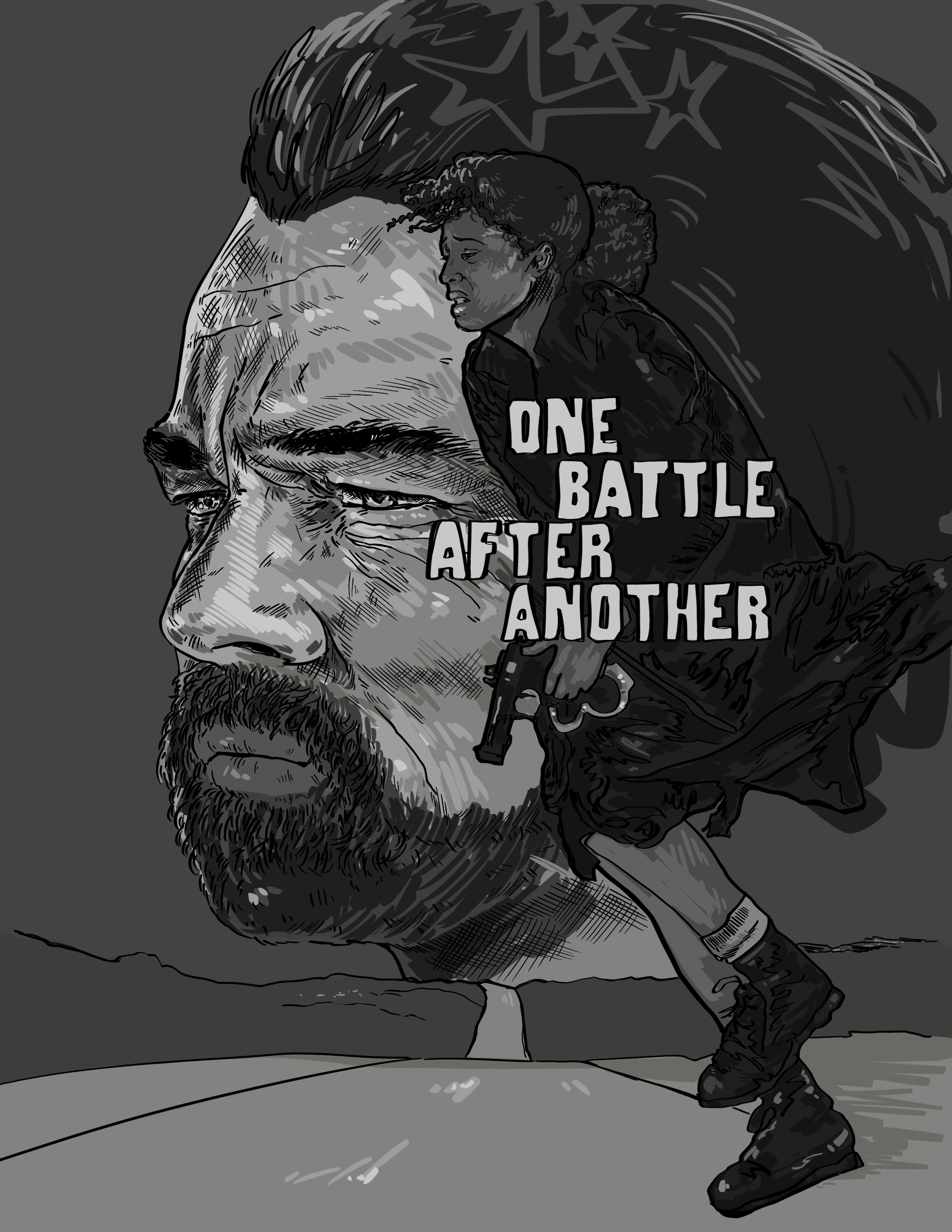
Art by Sara Polster
Jumping into action with a cold open, the audience is introduced to a group of revolutionaries named the French 75, and immediately thrust into their ambush of an immigrant detention center headed by Colonel Lockjaw (Sean Penn). Led by Perfidia Beverly Hills (Teyana Taylor) and armed by Pat Calhoun a.k.a. Rocketman (Leonardo DiCaprio), the group launches a loud and almost gaudy attack, with the group members revealing their faces, announcing their names, shooting arrogant celebratory shots and announcing to the world that their ‘saviors’ had arrived. This was the first in a series of attacks that make up the film’s prologue, all of which pursue an anarchical tone, highlighting a radical revolution of sex, violence and most of all, American liberty.
Romance blossoms between Pat and Perfidia leading to the birth of their daughter, Charlene, an event that coincides with the downfall of the French 75. The end of this operation forces the two revolutionaries to be pulled in opposite directions; after a 16-year timeskip, Pat and Charlene are reintroduced under the new identities of Bob and Willa, with a newly motivated Col. Lockjaw hunting them down.
Willa (Chase Infiniti), now a 16-year-old high schooler, is an independent, self-sufficient, star student who perfectly contradicts her now messy, paranoid, drug-addicted and alcoholic father. These separate personalities pull the audience into two different perspectives as the story unfolds. Following a strung-out Bob as he struggles to revert to his past revolutionary ways for his daughter’s sake is the perfect mix of comedy and anxiety-inducing drama. The characters create a balance that perfectly plays off each other, despite them being separated for the majority of the film.
“One Battle After Another” is the type of movie that grips you in during the first second and refuses to let you go. Anderson’s use of close-up shots and painfully slow zooms spotlight actors' performances, almost like a theater production. These prolonged scenes stretch into extended silence, creating a suspenseful and tense atmosphere that leaves the audience on the edge of their seats. These moments are only amplified by the enthralling score that - like some shots - is leisurely drawn out in an anxiety-inducing manner.
Anderson writes in a manner that balances both drama and humor, crafting a script that presents complex and dark topics in a way that is palatable and easy to consume. Jokes snuck into prolonged, plot-heavy scenes help keep the audience engaged and entertained throughout the lengthy run-time. They wonderfully break up expository dialogue to make it feel less overwhelming while successfully developing the story.
The movie follows the point of view of both the military and the revolutionaries, creating a strict contrast between authority and defiance. The constant shot-reverse-shot between the hunter and the hunted puts the audience into the position of both parties. Still shots positioned to be peering through windows which cut to hand-held cameras tracking the nervous movements of the subject push two distinct perspectives onto the viewer. Being propelled into this role of ‘surveyer’ makes the audience feel as though they’re a part of the film, but also as if they know something they aren’t supposed to.
Emphasizing this division, Anderson juxtaposes government violence with civilian violence. The military’s brutality was consistently targeted at innocent citizens, highlighting their skewed perception of what a threat might be. They saw opposition as a danger and therefore sought to crush it.
On the other hand, actions committed by the revolutionaries fall under an umbrella of ambiguity; the work they do is destructive and disruptive, but it is justified by their intentions to better the world and criticize the corrupt government. The film also works to radicalize this violence, expressing Colonel Lockjaw’s neo-nazi-esque motivations and his distaste for any and all minorities.
Amidst the recent Immigration and Customs Enforcement (ICE) raids and nationwide protests, this movie is nothing short of extremely timely and poignant. It leaves the viewer wondering to what extent the government can perpetrate violence before it is considered an abuse of power. During an initial viewing, it appears that Anderson somehow created a distant and dystopian environment overwhelmed with chaos and injustice lingering under the surface. But once you take a step back to observe the bigger picture, it becomes clear that this seemingly faraway world perfectly mimics our own.